Insights
Expecting the Unexpected: A Journey with Medical Specialists

Over the past year, we in LLInC’s Futures Thinking team have continued developing and expanding our work within the futuring field. We’ve had the opportunity to introduce professionals in and beyond education to new ways of exploring the future—ways that stretch the imagination, challenge assumptions, and reveal what it really means to be prepared for the unexpected.
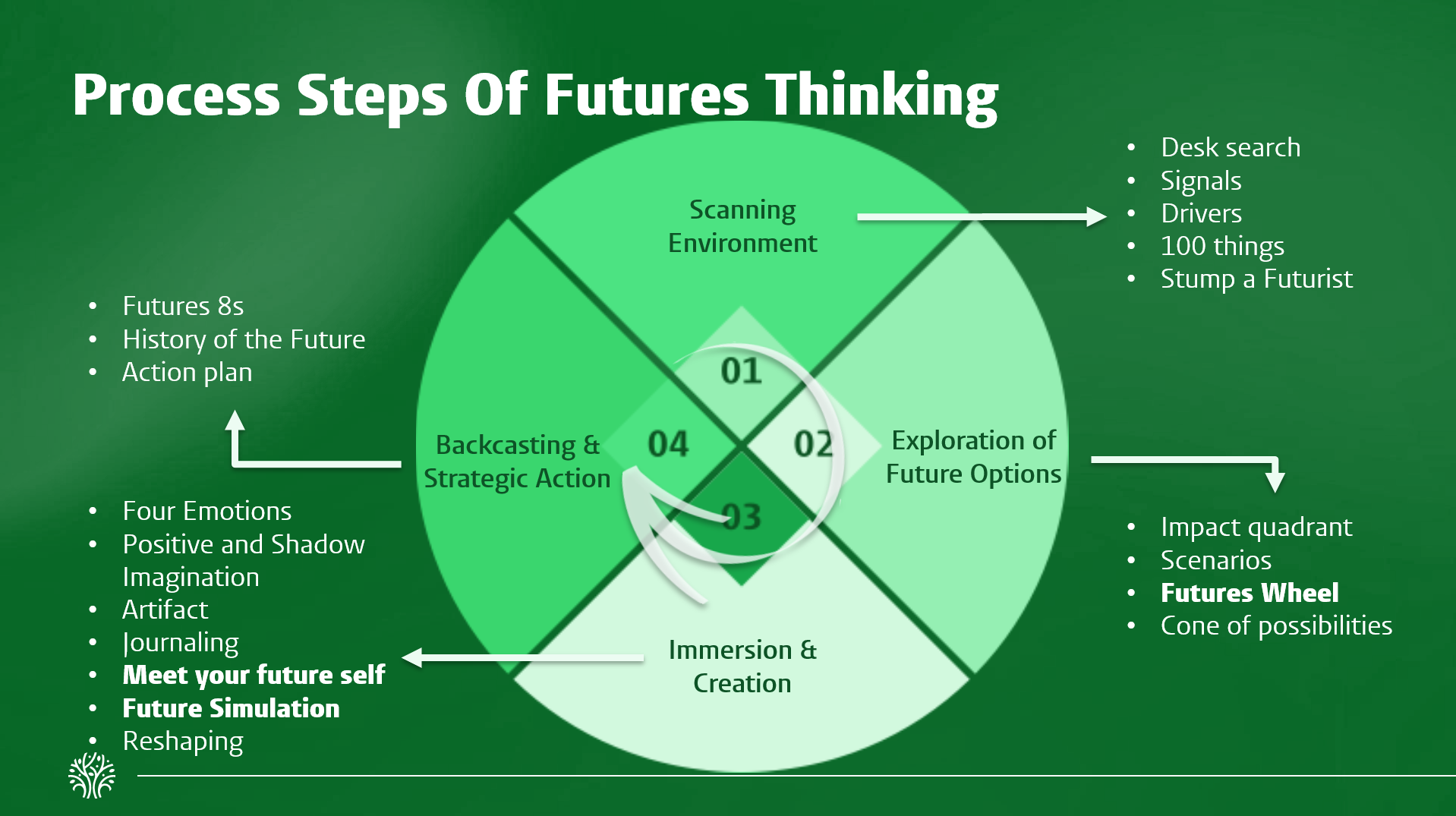
All image credits to the Futures Thinking team.
Imagining Tomorrow’s Healthcare
One of the highlights of this journey has been our collaboration with the Federation of Medical Specialists. For their Medical Specialist 2035 conference, we developed and hosted two workshops, delving into various visions for the coming decade of medical practice.
In these sessions, participants stepped into the year 2035. Having chosen a negative, positive, or in-between scenario, their aim was to evaluate its impact on their work as well as on themselves more broadly. These two workshops were as follows:
Workshop 1: The Futures Wheel
In the Futures Wheel workshop, medical specialists examined how major developments—whether technological breakthroughs or severe disruptions—could ripple through society and the healthcare system. Consequently, they began to consider the question of what happens when a new technology transforms diagnostics or when a crisis leaves hospitals without their usual tools and systems.
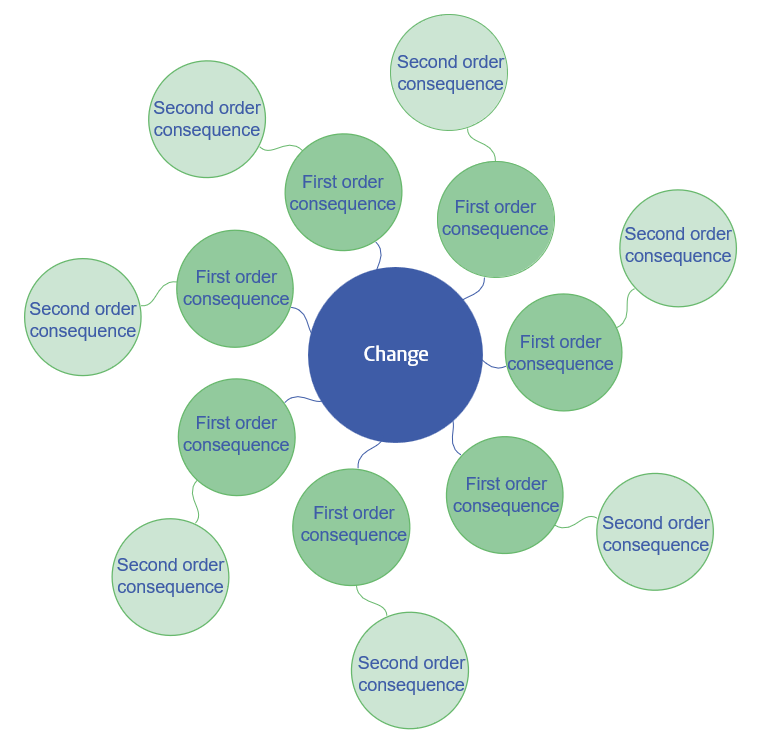
Using the ‘futures wheel’, participants were pushed to be specific and concrete, mapping both the immediate and long-term impacts of their imagined future. This sparked lively discussions about what it means to be an effective medical specialist when the world around you changes faster than expected.
In the picture below is a schematic example of a futures wheel. In the middle is the future (or change) as presented in the scenario. One can then fill in consequences in the adjoining circles, before going further by sketching 2nd and 3rd thoughts, emanating from these inner circles (consequences).
Workshop 2: The Future You (with LEGO!)
In the second workshop, The Future You, participants explored how they themselves might evolve in their chosen future scenario. Using LEGO to unlock creativity, they built visual representations of their future professional selves based on the following questions:
- How do you see yourself in the future?
- Who are your colleagues in 2035 and what kind of job do you do?
- Would you adapt to the new reality and find new exciting ways to do your job?
- Would you struggle to cope with change and feel primarily disoriented and scared?
This playful method led to unanticipated deep reflections about adaptability, resilience, and professional purpose.

An Immersive Crisis Scenario
Following the conference, LLInC collaborated with the Federation as well as professionals from the medical field to develop a fully immersive crisis simulation. This scenario combined two high-pressure events: a major hospital blackout and a mass influx of patients. With electronic systems down—including the Electronic Patient File (EPD)—participants had to improvise, collaborate, and make decisions without the safety net of protocols or technology. The goal of the workshop was to make participants aware of the importance of looking to the future and experiencing the unimaginable. In this way, when it does happen, you are better prepared.
The exercise made one thing unmistakably clear: being prepared for the unexpected is not optional. It’s essential. During the recap at the end of each simulation, participants shared which aspects they were least prepared for alongside other challenges brought to light by the activity. These included problems in relation to emergency plans only available online, having to handwrite prescriptions, and not knowing which medication to give to which patient because everything is recorded and stored online.
Looking Ahead
This past year, we have focused on the exploration of Future Scenarios and the impact of immersing yourself within these. Our collaboration with the Federation of Medical Specialists has only strengthened our belief that actively engaging with future scenarios is a powerful way to build awareness, spark conversations, and develop adaptability—a great demand within modern healthcare. Since this is only a part of Futures Thinking, there is still much to explore!
Interested in finding out what Futures Thinking could achieve for your organisation? Take a look at our website or contact us at futures@llinc.leidenuniv.nl.