
Interview with SpatialMind: prototyping, progress, and a promising future

The winner of the 2025 Grassfields grant for upscaling educational innovations, SpatialMind is a project which leverages augmented (AR) and virtual reality (VR) technology to make 3D learning materials widely available to students of all spatial skill levels.
Although many courses in higher education rely on 3D visualisation for a solid understanding of the course material, levels of spatial reasoning skills among students vary greatly. As the project team explains in this catch-up interview approximately one and a half years after their success with Grassfields, SpatialMind aims to narrow this gap through experimentation with VR.
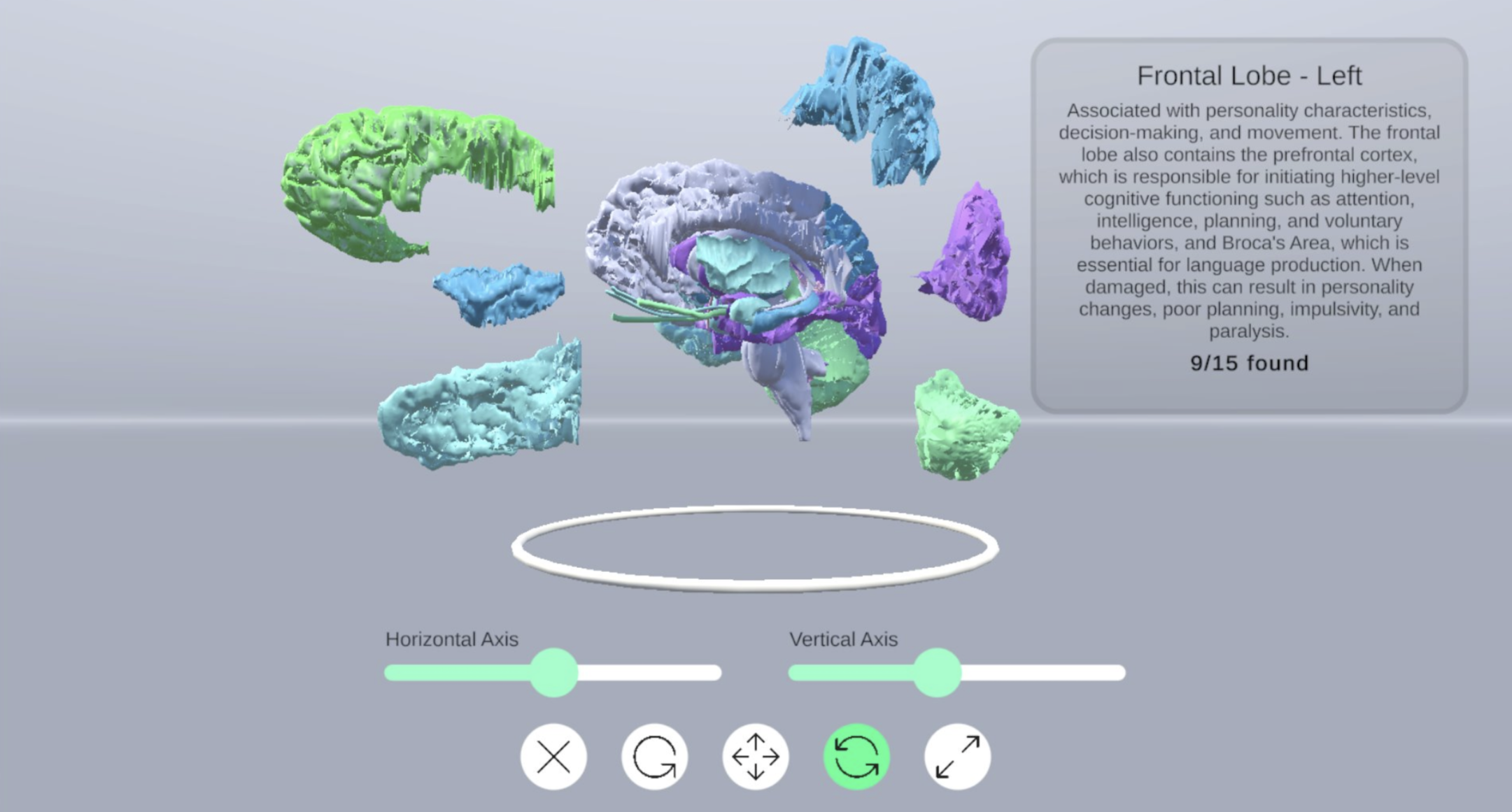 Image credit to the SpatialMind team.
What stage are you currently at in your project? What have you achieved so far?
Right now, we are wrapping up data collection for the first experiment. In this study, we looked at a few main design factors:
- Presentation format: 2D versus 3D
- Learning style: free exploration versus guided learning
- Testing congruency: matching or mismatching learning and testing formats (2D→3D and 3D→2D)
In addition to examining overall learning outcomes, we are also investigating which types of information are most affected by learning in VR. To measure this, we developed a quiz which includes four kinds of questions concerning the names, functions, locations, and spatial relations of various brain structures. Since VR provides depth cues and encourages active spatial exploration, we anticipate that the technology will give students an advantage, specifically in tasks which rely heavily on spatial understanding. This will impact their answers.
Simultaneously, we are preparing the next step of the project. In the first experiment, we used an object-based model—a 3D anatomical brain which students could manipulate by grabbing and removing structures to explore their shapes, functions, and spatial relations. Building on insights from this phase, our next experiment is to move toward a scene-based or landscape model. This will allow us to investigate how various design features influence learning in a more dynamic, virtual environment.
Can you tell us about the specially developed 2D and 3D prototypes? How are they being used?
We developed both 2D and 3D versions of the learning environment to compare how students learn in each format. Previous research suggests that 3D VR environments often lead to better learning than traditional 2D screens. For this reason, part of our goal is to observe whether our own prototypes demonstrate the same effect.
Additionally, widespread adoption of VR tools in education requires accessibility and flexibility. Not all students have access to VR headsets and not all settings are equipped to support them. For that reason, a core goal of the project is to build a flexible, scalable platform which allows educators to upload their own 3D models for use in both VR and 2D screen-based environments. Including 2D prototypes in our research is therefore essential. It helps us understand which design principles support learning across both formats and where differences emerge.
Are you noticing a difference between the students’ responses to the 2D and 3D prototypes? What feedback have you received?
Yes, we have definitely noticed a difference. Students are very enthusiastic about the VR version. They often say they feel much more immersed and, despite the amount of information they need to learn, that they actually enjoy the process. Many students also spend extra time playing around with the model, especially in the free exploration condition. This shows that the 3D VR environment naturally encourages exploration.
Students working with the 2D version are, in general, also positive. Some, however, mention feeling limited in how much they can explore and a small number report that the controls feel less intuitive. In addition, students using the 2D condition pointed out that interacting with a 3D model on a 2D screen isn’t as new and exciting to them as the VR version would have been. The students who experienced both the 2D and the 3D version mentioned that the controls were less intuitive in the 2D version, compared to the 3D VR version of the prototype.
We are currently performing the statistical analyses to see whether these subjective differences are reflected in actual learning outcomes.
 Image credit to the SpatialMind team.
Which aspects of XR technology appear to have the most impact on students’ learning?
Although data analysis is still underway, our early results suggest that test congruency—that is, whether the testing format (2D or 3D) matches the format in which students learned—plays an important role in learning outcomes. If these effects hold in the final dataset, they may point to important considerations for future educational implementation.
If format congruency significantly affects performance, it may be beneficial for institutions to reconsider aspects of examination design and how workgroup or practice sessions are structured. For instance, assessing students with 2D images after they have been trained in an immersive 3D VR simulation may disadvantage them, whereas allowing them to demonstrate knowledge within a similar 3D environment could lead to more accurate evaluations of their understanding. Institutions might therefore consider integrating VR-based assessments or hybrid exam formats to align collaborative practice sessions with the same modality used in the final assessment, rather than switching between 2D and 3D formats.
What are the next steps for the SpatialMind project?
Our immediate next step is to explore how learning can be optimised in a scene- or landscape-based VR environment which introduces movement and navigation into the learning experience. We aim to investigate which design features are most effective in this more complex spatial context.
Depending on the outcomes of this second experiment, we will continue expanding the platform by integrating additional design features which have not yet been systematically tested. Ultimately, our goal is to identify and refine a broad set of evidence-based design principles which maximise the educational effectiveness of VR learning tools in higher education.