Learning by Doing: Active, Immersive & Game-based Approaches at LLInC

At LLInC, we advance game-based learning within and beyond higher education through immersive, purpose-driven learning experiences – designed and facilitated by our Serious Games team! We collaborate with educators and professionals alike to explore complex and interconnected challenges through pedagogy-informed and practice-oriented approaches.
In doing so, we create spaces where learners from various practical contexts can apply knowledge, experiment with decision-making, and develop key competences such as collaboration, adaptability, and systems thinking.
In an increasingly information-rich and volatile world, higher education plays a central and crucial role in equipping learners not only with disciplinary and conceptual knowledge, but also with the skills, tools, and self-efficacy required for critical, independent thinking and informed action. In line with Leiden University’s vision for teaching and learning, LLInC explores a wide range of active, experiential, and learner-centered pedagogical approaches to bring this vision into practice. These approaches aim to support the development of transferable skills, and to create engaging, meaningful learning experiences across various educational contexts.
A clear example of this is our work with game-based and immersive learning:
Serious Games
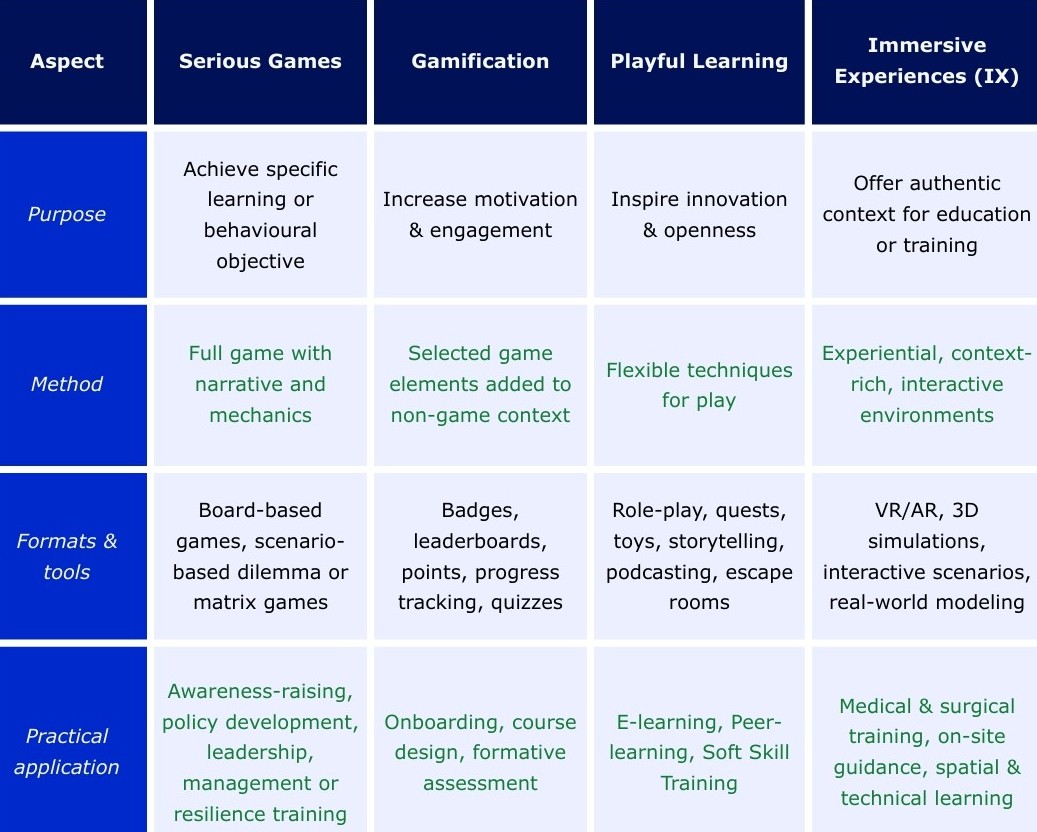
Serious Games are purpose-built learning formats which integrate clear learning objectives into immersive, game-based experiences. Unlike entertainment games, they are specifically designed to nudge players (learners) towards applying subject-specific knowledge and/or skills to progress within the dynamics and storyline of the game environment. This makes serious games particularly effective for developing adaptability and resilience or training complex competences such as problem-solving, decision-making under pressure, collaboration, and systems thinking (see 13 Transferable Skills). Serious Games, with learning as their end goal, can be implemented in both analogue (e.g. tabletop exercise, role-based simulation, mixed reality experience) and standalone digital formats (e.g. online game). Examples:
- Crisis Simulation Exercise for Leiderschap in Nationale Veiligheid (LNV) Programm. Dutch Ministry of Defense (2023-now)
- Serious Gaming with Expertisenetwerk Hoger Onderwijs (EHON) at SOP event (2025)
Interested in learning more or organising a serious game session? Visit our Serious Games webpage to see how you can collaborate with us!
Gamification
Gamification is an instructional approach characterised by the integration of game elements -such as points, challenges, rules, roles or progress tracking- into non-game educational contexts. It encompasses a range of structured activities which draw on the motivational affordances of games to enhance learner engagement, support knowledge acquisition, and facilitate skill development across diverse learner groups. Within higher education, gamification is often applied to enrich existing course designs by making learning activities and instructional sessions more interactive, rewarding, or competitive, without requiring the development of fully realised game environments. Examples:
- Health & Safety Training Module with Science (2024)
- LEGO workshop for Interdisciplinary Course Design (2025)
At LLInC, we offer advice, consultancy and workshops on how you can use gamification to make your class, course or programme (more) engaging!
Playful Learning
Playful Learning is a pedagogical approach that highlights the roles of curiosity, experimentation, imagination, humour, and low-stake exploration within the learning process. It encourages the construction of new knowledge and skills by letting learners wonder, take risks, even fail, and critically reflect on both the learning experience and content. This approach typically involves a range of learner-led and open-ended formats such as escape rooms, storytelling, role-playing, or team-based challenges. Examples:
- Escape Room with Anthropology Bachelor Course (2021)
- Dialogue Method Project with African Studies Course (2024)
- Scrollytelling Project (2024)
Many of the training courses and workshops offered at LLInC incorporate elements of playful learning that add value to the learning process and align with the learning objectives.
Immersive Experiences (IX)
Immersive Experiences (IX) are compelling and contextually-rich (user) experiences in which digital and physical elements merge to create an additional, digital layer to reality that goes beyond VR and AR glasses. Examples:
- Ultrasound app
- 3D Scanning in Archeology (2024)
- SpatialMind Project with FSW, Humanities, and LUMC (2025)
For a detailed description, please visit LLInC’s Studio webpage or explore LLInC’s IX offer!
Ultimately, learning by doing highlights the value of active learning as a process in which knowledge is not only acquired, but applied, tested, and reflected upon. Regardless of the form the experience takes —whether through a game, playful technique, simulation, or interactive environment— we at LLInC strive to make learning more meaningful, memorable, and transferable to practice.
For questions on the topic, consultation or collaboration requests, please contact us here: gamified@llinc.leidenuniv.nl